


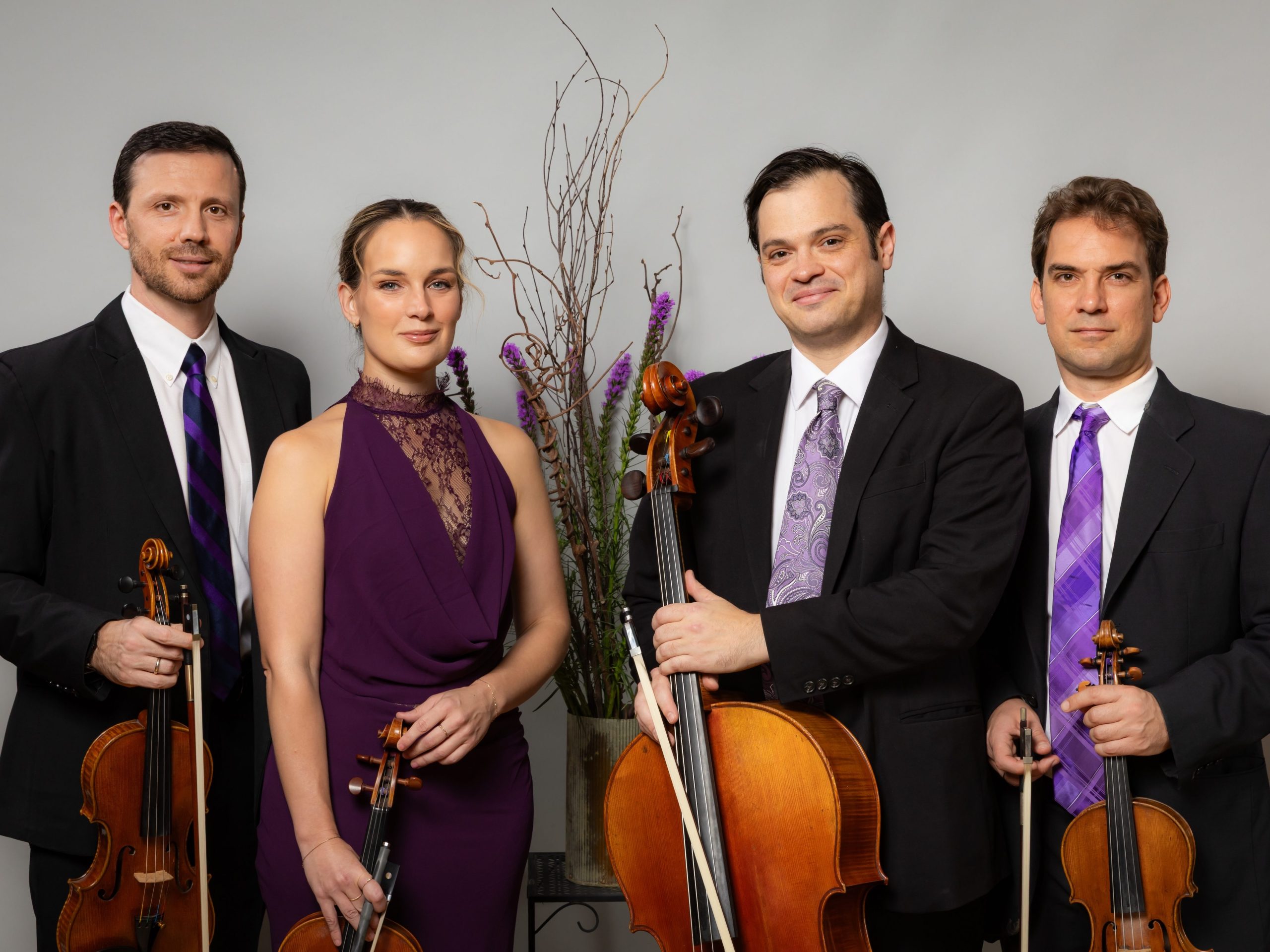
The liatris or “blazingstar” is a flowering plant native to the central prairie. Called liatris punctata in Latin (to name one of the more common species to our region), it is resilient against harsh elements, it bursts forth with intense purple fronds in late summer and early fall, and it often springs up to fill a landscape recently laid bare by prairie fire.
Liatris is thus in many ways an ideal name for Kansas City’s newest professional string quartet, which has emerged from a previous ensemble: Three of the four musicians were members of Opus 76 Quartet.
This ensemble’s focus is to establish a bright new future. “The mission of our group is to provide beauty to the region,” said cellist Dan Ketter, who first floated the idea of naming the quartet after a tenacious, flamboyant prairie flower. “We all live in Kansas City, we are presenting concerts in the region, and we’re building partnerships with organizations here.”
The liatris or “blazingstar” is a flowering plant native to the central prairie. Called liatris punctata in Latin (to name one of the species that is common to our region), it is resilient against harsh elements, it bursts forth with intense purple fronds in late summer and early fall, and it often springs up to fill a landscape recently laid bare by prairie fire.

Like the flower from which the Liatris Quartet draws its name, he added, the Quartet strives “to help beautify this area of the plains with beautiful music.” (The liatris was named Wildflower of the Year in 2022 by the Kansas Native Plant Society.) And because native flowers are most resistant to adversity, Dan said, the liatris (lee-AT-ris) “is a symbol of renewal and resilience.”
On November 12th at Grant Recital Hall, University of Missouri-Kansas City, the Liatris String Quartet presents its debut performance. With music by Schubert (Quartettsatz), Haydn (Op. 20, No. 4), Hugo Wolf (Italian Serenade), and contemporary composer Judd Greenstein (Four on the Floor), these musicians are already signaling a broader vision than that of the quartet from which they emerged.
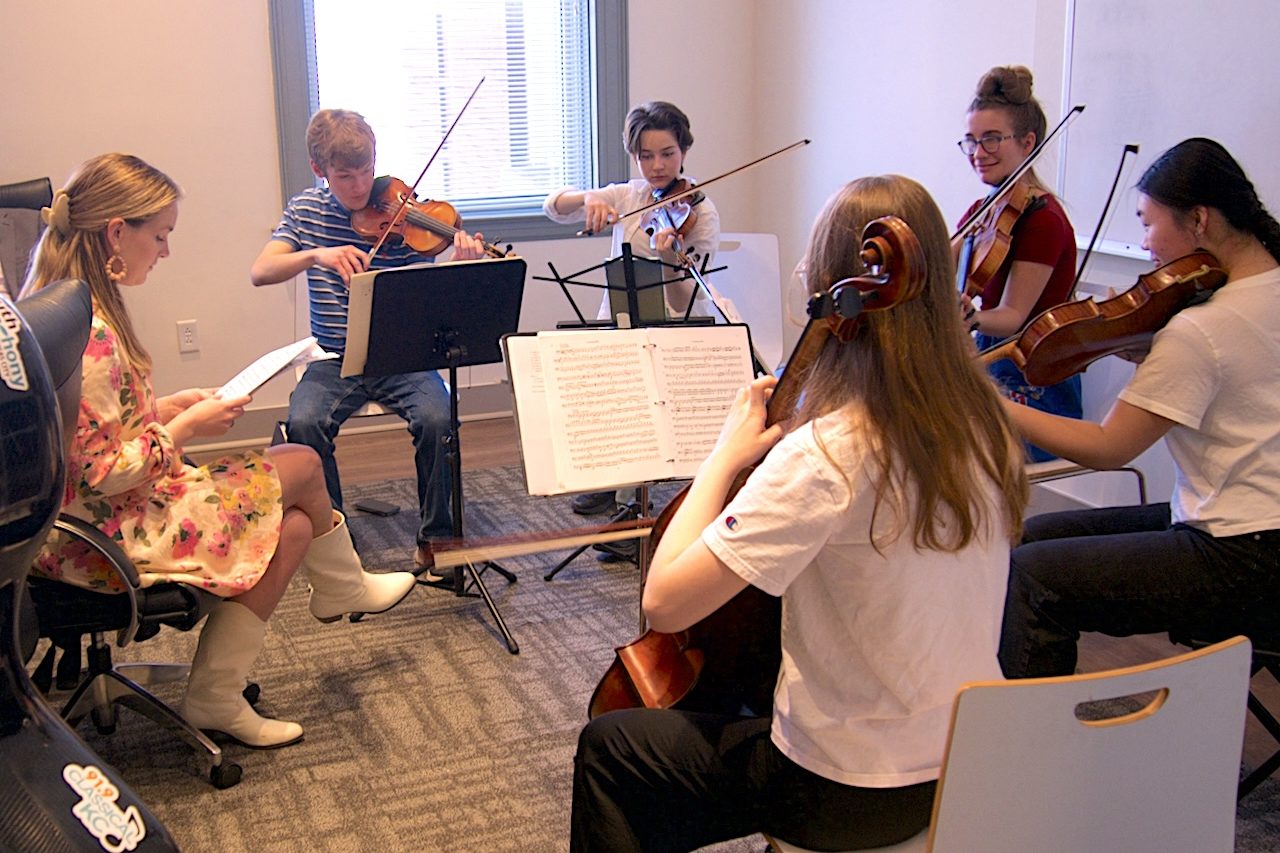
Composers from the late-19th, 20th, and 21st centuries will figure prominently into Liatris’ vision. “Of course we’ll still play music from all periods,” said violist Ashley Stanfield, “but we’re not necessarily going to put ourselves in a box of playing only specific repertoire.” Moreover, many of the previous group’s outreach and education programs will remain with Liatris Quartet, most notably the partnerships with the Youth Symphony of Kansas City (where, as Ensemble in Residence, they will continue to coach student chamber-music groups) and the Midwest Trust Center.
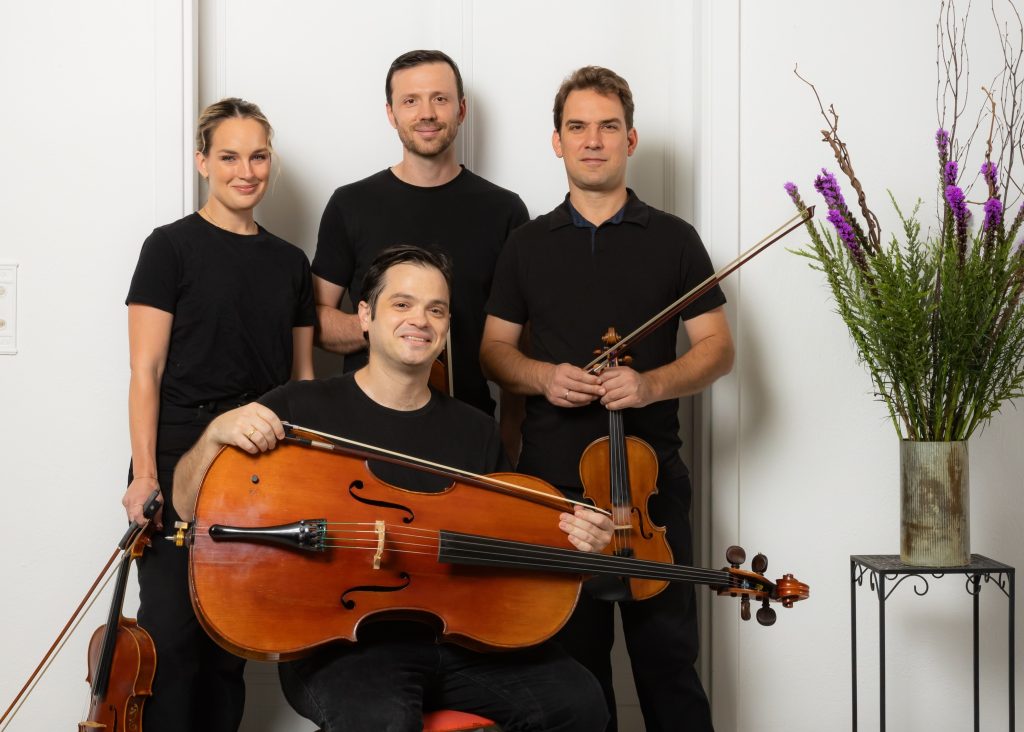
The plan for the first season is a four-concert series that are all underwritten—thus enabling free admission for all. “This is something that our board really wanted to do,” Ashley added. “It harkens back to the original message of the previous ensemble. We want to make sure that our programs are accessible.”
Meanwhile the community has treated this fledgling group with kindness and generosity. “People really care for the arts here,” Ashley said. “But there’s a difference between knowing that as an abstract concept, and having people come to you when your chips are down and say, What can we do to help? … It has made us feel like we are stewards of something that the community has been able to build, and we want to be the best stewards we can be.”
Each of the four musicians of Liatris is an established member of our regional music scene. Violinist Zsolt Eder teaches at the UMKC Conservatory Academy and serves as concertmaster of the Topeka Symphony, among other activities. Ashley Stanfield, who studied at the Royal Academy of Music in London, has performed with world-renowned musicians and conductors all her life, and with orchestras of our region as well; she is currently guest principal violist of the Sioux City Symphony. Dan Ketter, who studied at the Peabody Conservatory and holds a DMA from the Eastman School of Music, is an assistant professor of cello at The University of Kansas and co-founder/co-director of the American Wild Ensemble.
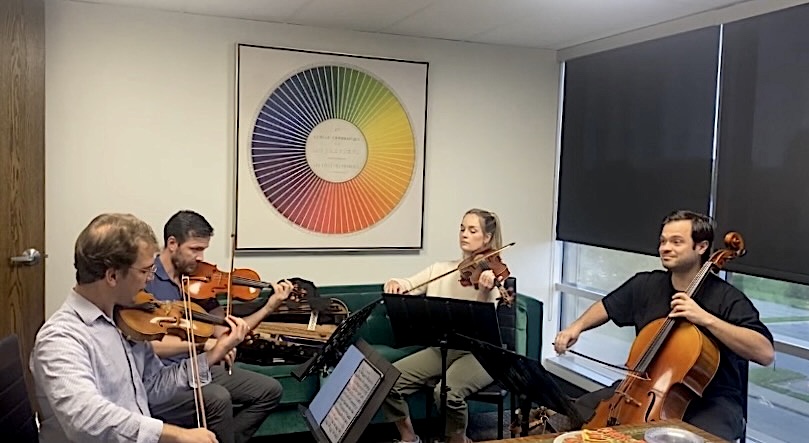
Violinist Filip Lazovski is new to this mix, but he is no stranger to these musicians, or to Kansas City. Originally from Macedonia, Filip studied at the Eastman School and at Kent State University and did graduate work in violin at UMKC.
Filip has performed on contract with the Kansas City Symphony for several seasons and is well known to local musicians.
“I’ve been to school with each of these musicians at different points in my life,” Filip said. “Ashley and I knew each other at Interlochen, Dan and I went to college together at Eastman, and Zsolt and I went to graduate school together. So it’s a cool thing that we all get to work together now.”
As a new member, “you have to bring yourself, bring who you are and the way you play,” he added. “Then you have to find the best possible way for the group to sound good, because that’s what we’re all going for: a united idea that comes through, finally, in the concert.”
Chamber-music performance has formed a central part of the lives of all four of these string virtuosos. Zsolt’s parents, both violinists from Hungary, were members of the world-renowned Eder String Quartet, which toured the world and made numerous recordings. “So I am kind of continuing the family business, I guess,” Zsolt said. “I grew up listening to string quartet music all the time, so it’s been a part of my life.”
The arrival of any new musician to an ensemble is fun and exciting—and perhaps a bit scary. In any chamber group, Ashley said, “you’re lucky if you get to play with people you admire as musicians on their own, and who bring exciting and fresh ideas to the group.”
Dan concurred. “It’s great to have another set of ideas to challenge us,” he said. “Everybody grows when you bring in new energy.” With a new ensemble comes a new musical vista. Few quartets in our region have ventured beyond a small, relatively conservative repertoire. Liatris hopes to change this, and eventually to explore commissions and collaborations with dance.
Ashley has already pitched a cycle of all six of the fiercely demanding quartets of Béla Bartók. “I think my colleagues are like, yeah well, eventually,” she said. Most chamber musicians have “an internal bucket list of pieces they really want to play, so in the beginning we kind of throw them out there … and we all look at these pieces together. The real challenge is if you can ‘sell’ a piece—if you can get the other members of the quartet as excited about it as you are.”
All four agree that being part of a string quartet—and finding a group of musicians that you actually like to spend time with—is itself a marvel. “Playing in a string quartet feels almost like a magic trick,” Dan said. “It sounds so amazing when the four parts blend, when you are musically of one mind.”
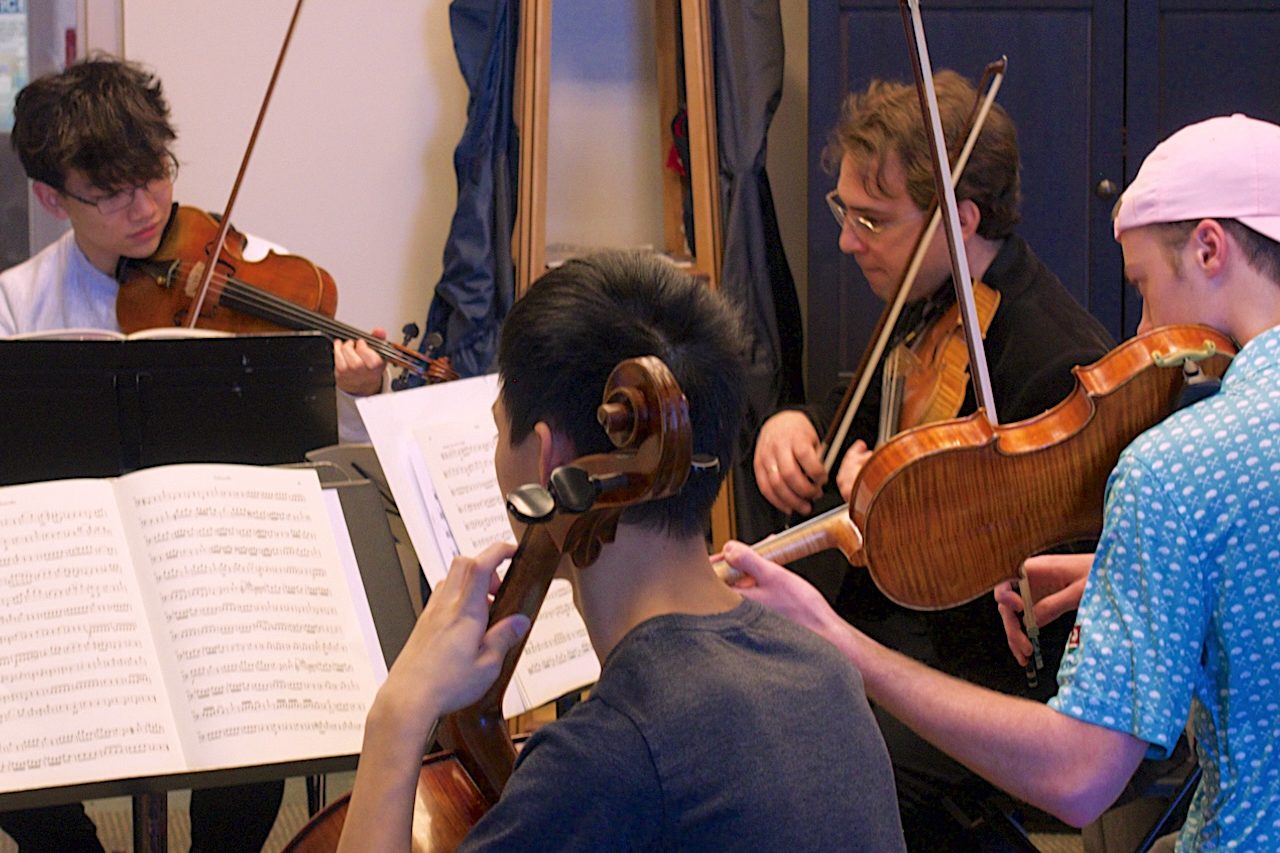
More to the point, he added, “considering how much work and commitment this takes, it’s even more amazing to find four people who decide they want to do this so badly that they will get together with you regularly to make it happen.”
If the goal is to bring beauty to local audiences, the Liatris Quartet is as committed to this as any group you will find. “We want to continue to enrich the artistic experience of Kansas City,” Ashley said, “and continue to improve access and education. We hope to provide the highest level of artistic product that we can, because this area deserves it.”
—By Paul Horsley
Liatris String Quartet presents its inaugural performance on November 12th at Grant Hall, University of Missouri-Kansas City. Admission is free. For more information about the ensemble, find them on Instagram at @liatrisquartet. To reach Paul Horsley, performing arts editor, send him an email (paul@kcindependent.com) or reach him on Facebook or on Instagram or X (@phorsleycritic).
