


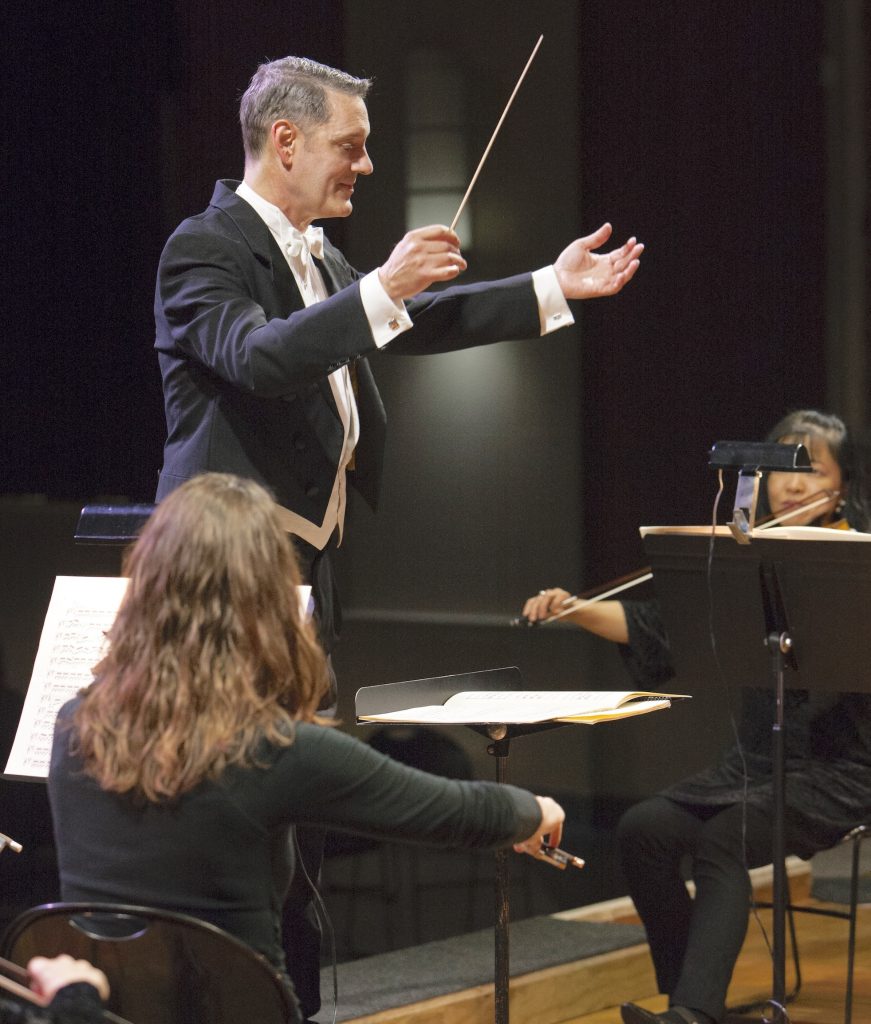
It’s difficult to imagine a higher calling for a nonprofit performing-arts organization than to provide employment for local artists. For four decades the Kansas City Chamber Orchestra, perhaps more than any other medium-sized ensemble in town, has offered concerts at an exceptionally high level using almost exclusively members of the Kansas City Symphony, faculty members and advanced students from local universities, and others from the region.
“We provide extra performance opportunities and income for professional musicians,” said Bruce Sorrell, Chamber Orchestra founding music director, “and we feature local talent as soloists, as well.” As the group celebrates its 40th season beginning this October 20th, it joins the explosion of performing arts organizations now competing for audiences and financial support. “One of the major problems we’re running into now is the ability to find dates in the venues we use,” Bruce said.
Virtually every city with a symphony orchestra also has at least one chamber ensemble that operates parallel to that orchestra. These groups draw from a vast repertoire of works from recent centuries that have been written specifically with a chamber-sized group in mind, and they play Baroque- and Classical-period music with an ensemble whose size (30-40 players) is more historically accurate to the style.
“An orchestra of musicians playing modern instruments can still approach an early-music sound world that makes sense to the period,” Bruce said. It helps that music of this period is Bruce’s specialty: Some of the most satisfying local performances of this repertoire has been at the concerts of this remarkable Chamber Orchestra.
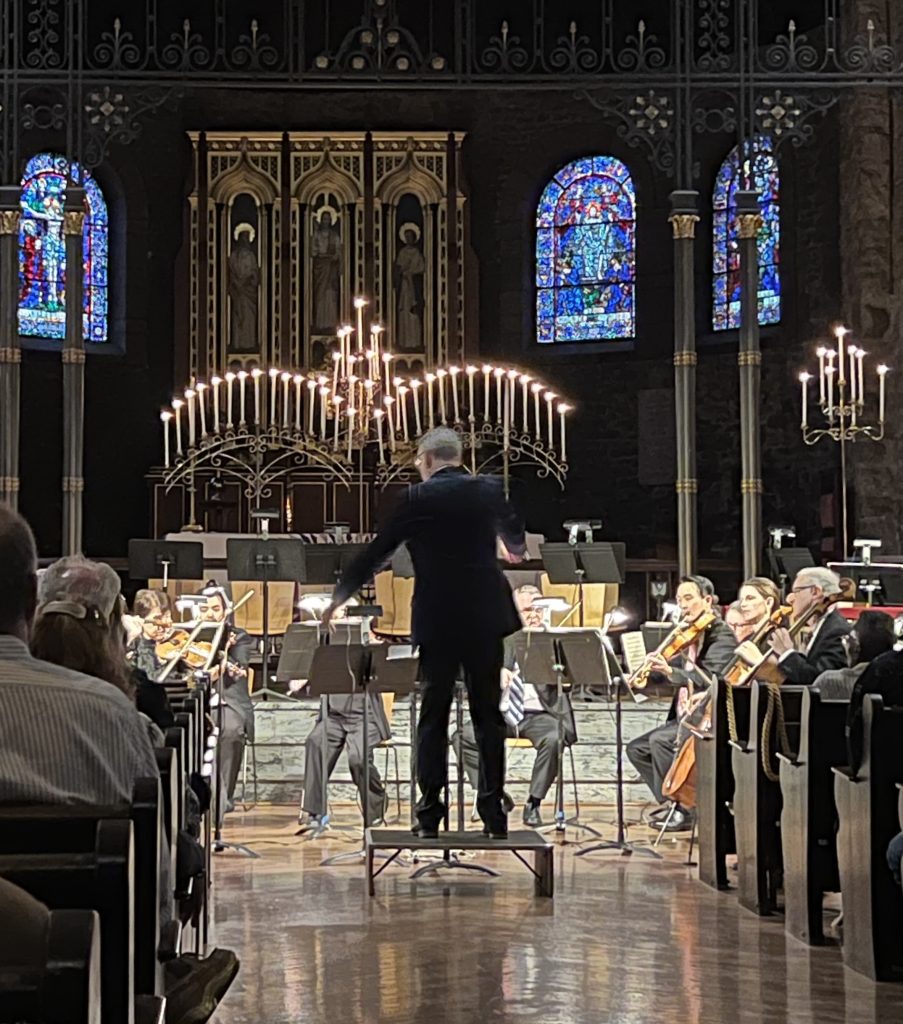
The group’s impressive 40-year performance history includes early masterworks such as Bach’s Magnificat, Coffee Cantata, and Brandenburg Concertos; Vivaldi’s Gloria, Purcell’s The Fairy Queen, Haydn’s Lord Nelson Mass, Mozart’s Requiem, and the local premiere of a newly discovered Gloria by Handel.
There are also dozens of symphonies of Haydn, Mozart, and their lesser-known contemporaries; symphonies of Beethoven, Schubert, Mendelssohn, and Schumann; and a host of contemporary works of Stravinsky, Ravel, Prokofiev, Bartók, Janáček, and Peter Maxwell Davies.
Among the Americans are Charles Ives, Paul Creston, Aaron Copland, Paul Hindemith, Kurt Weill, Samuel Barber, Amy Beach, Ellen Taaffe Zwilich, Jean Belmont Ford, Forrest Pierce, Coleridge-Taylor Perkinson, George Walker, John Corigliano, Ricky Ian Gordon, Caroline Shaw, Jessie Montgomery, Stacy Garrop, and Dorothy Chang.
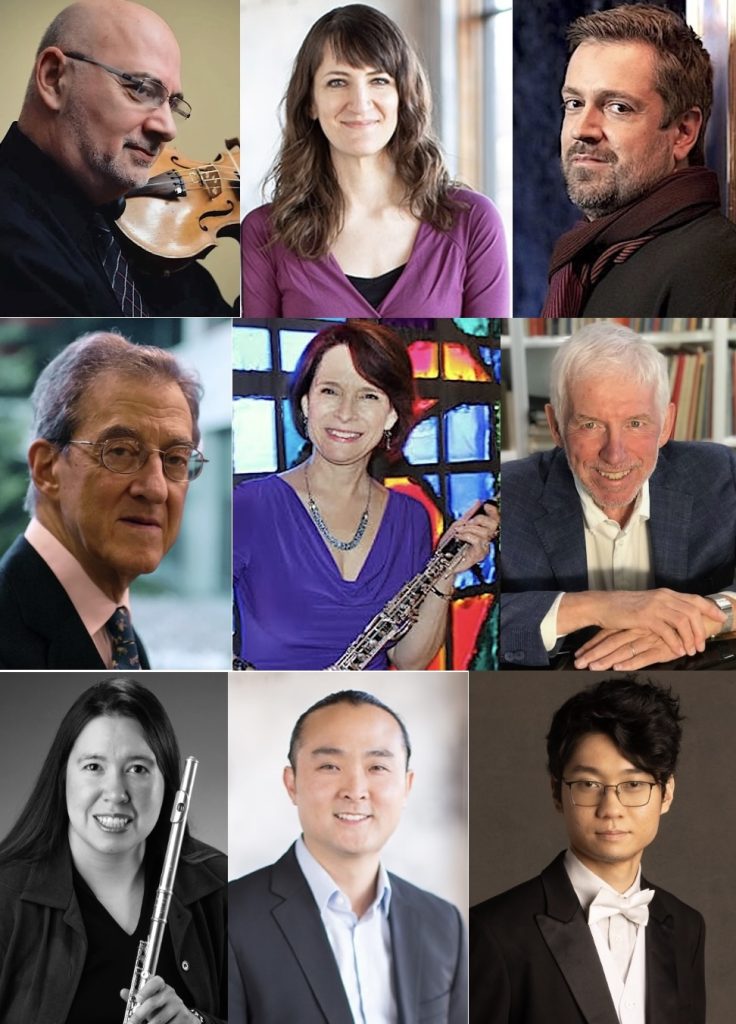
Guest soloists have included violinists Ben Sayevich, Kathy Haid Berry, Maria Ioudenitch, Ilkhom Mukhiddinov, Laurel Gagnon, Anne-Marie Brown, and Tamamo Gibbs; pianists Sequeira Costa, Artur Pizarro, Robert Weirich, Leon Fleisher, Kenny Broberg, Stanislav Ioudenitch, and Behzod Abduraimov; organists John Schaefer and John Obetz; violists Sean Brumble and Duke Lee; cellists Larry Figg, Allen Probus, and Dilshod Narzillaev; flutists Lyra Pherigo and Christina Webster; oboists Barbara Bishop and Margaret Marco; clarinetist Jane Carl; bassoonist Marita Abner; and French hornist Elizabeth Freimuth; and vocal soloists Sara Tannehill Anderson, Victoria Botero, Connie Dover, Kelly Morel, Jay Carter, and Daniel Belcher. Carolyn Watson is principal guest conductor.
Recently we conversed with Bruce about the Chamber Orchestra’s past, present, and future:
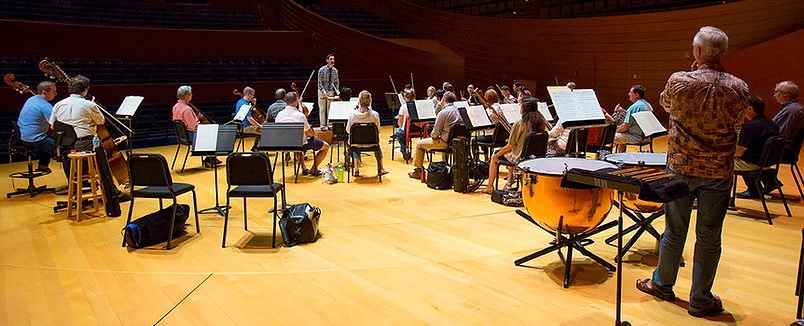
The Independent: When you first started this in 1987, did you ever imagine that it would last this long?
Bruce: I’m not sure what I thought. I’ve often joked it was a little like Mickey and Judy putting up a curtain and putting on a show. I don’t think we really knew what we were getting into. But here we are, 40 years later.
What was the initial spark that made you want to form this group? Were there other similar groups in town at the time?
While I was doing graduate work in Dallas, I had formed a small volunteer chamber orchestra to explore some of the neglected trove of music from the mid-18th century. I largely found out it was neglected for a reason. But we had fun and it gave me good experience organizing such a venture. Then while studying conducting in London a year later, my conducting mentor and I had conversations about next steps to build my career.
When I mentioned that Kansas City didn’t have a chamber orchestra, he really liked that idea. I think there had been a chamber orchestra but it was no longer in existence. … There was definitely a niche for a chamber orchestra size ensemble.
What were the early years like: Did you hire KC Symphony players from the start?
In fact, no. Violinist Ben Sayevich had just been hired on the faculty at KU and his wife at that time, Kathy Haid Berry, was also a very fine violinist; with me, they helped launch the orchestra. Also involved in the early stages was Michael Huebner, a musicologist and critic. So, while not exclusively so, the musicians in the early years were mostly not KC Symphony players.
Could you cite some personal highlights or favorites over the years?
Purcell’s The Fairy Queen was one of the brilliant things we did. It was an artistic triumph, and a logistical, theatrical one as well. I never imagined the final product would be so, well, beautiful. Just stunning.
Commissions from composers in the Kansas City region also stand out. We returned to Forrest Pierce’s The Twelve Kisses last April and we will revisit Jean Belmont Ford’s Remembrance in October. Commissioning that was the only NEA grant we’ve had over the years. Almost any time baritone Daniel Belcher has appeared with us, the result was such a delightful surprise. Recently, Ravel’s Concerto for Left Hand with pianist Stanislav Ioudenitch was a standout.
Are there some works you had wanted to perform but didn’t get around to?
We’ve performed eight of Beethoven’s nine symphonies and I have often thought about programming the ninth, or for that matter the Missa Solemnis. Some of the most compelling performances I heard of either of those works were in chamber orchestra-sized settings. But I’ve really enjoyed exploring music by contemporary composers of late. What a treat!
When you approach donors and foundation support, what are the points you emphasize for why Kansas City needs KCCO?
We support local professional musicians with very low overhead as an organization. Most of the administrative functions are still done on a volunteer or contract basis. We provide playing and earning opportunities for professional musicians who make Kansas City their home. We also provide solo opportunities for local musicians that really allows them to shine.
How has the profile, and perhaps the mission, evolved over the 40 years since the founding of KCCO?
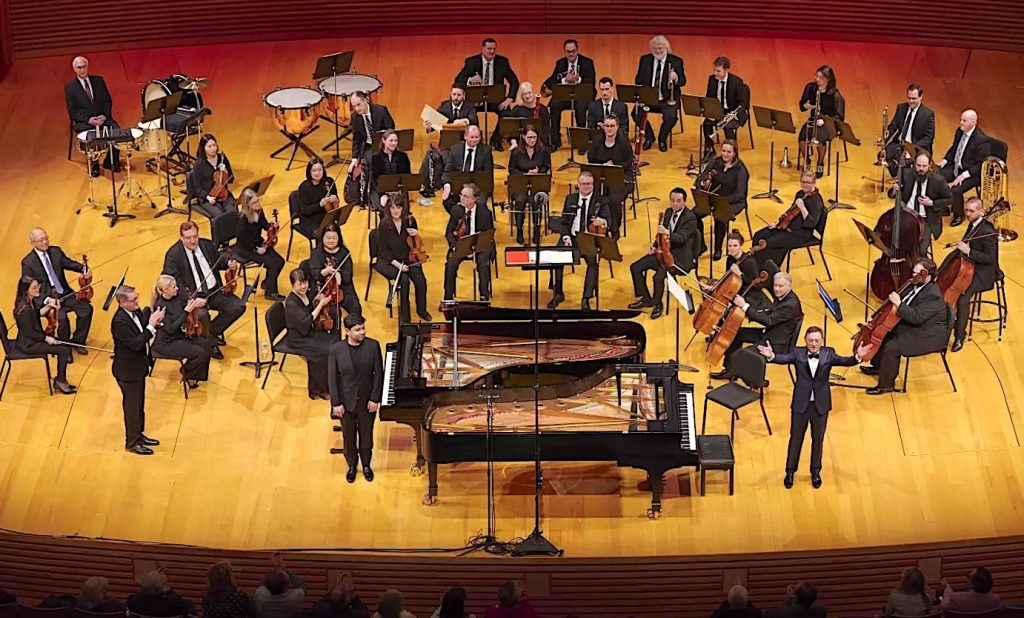
The mission of providing an orchestra dedicated to the chamber orchestra repertoire, highlighting music from the late Baroque and Classical eras, and performing works of today, are still very much how we operate. That really hasn’t changed. I know that already, from the dedication of the musicians who have played with us for years, that this matters. We matter.
—By Paul Horsley
The Chamber Orchestra opens its season on October 20th with Autumn Glow, a program of Jean Belmont Ford, Peteris Vasks, and Tchaikovsky. Call 816-960-1324 or see kcchamberorchestra.org. To reach Paul Horsley, performing arts editor, send an email to paul@kcindependent.com or find him on Facebook (paul.horsley.501) or Twitter/Instagram (@phorsleycritic).
